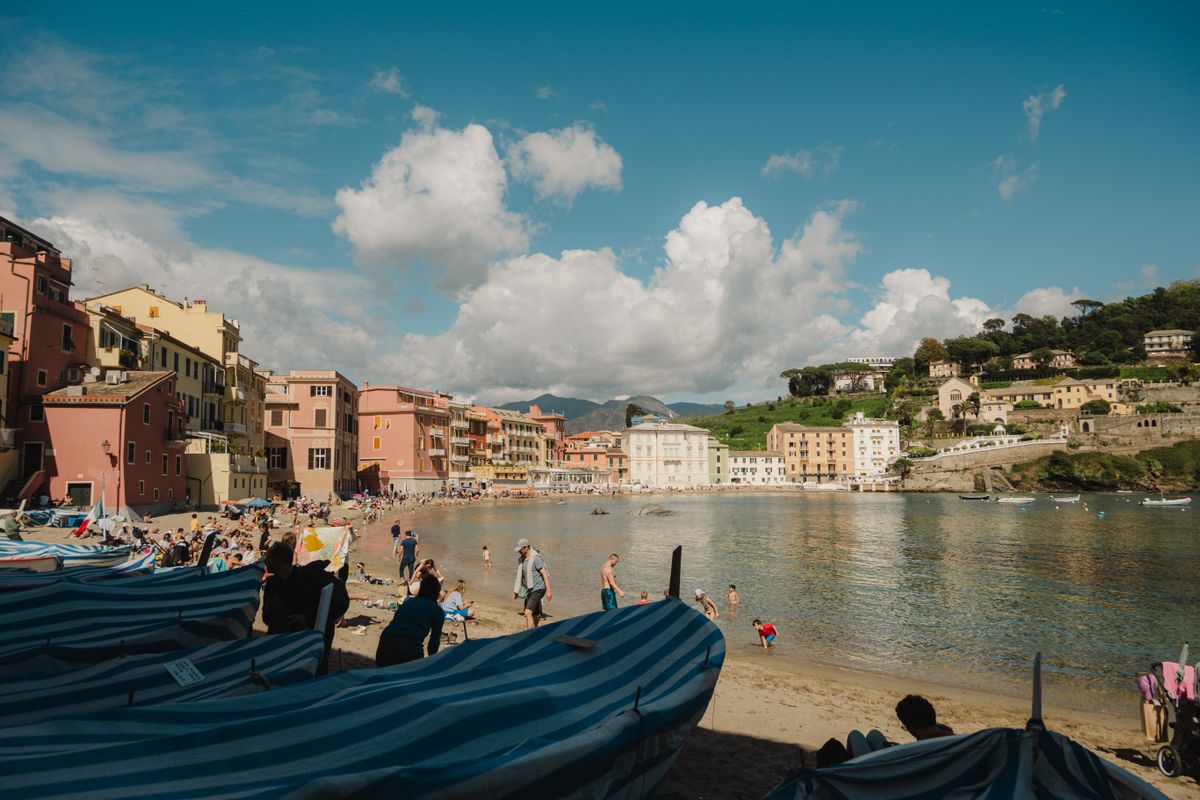
Sestri Levante beaches come in two kinds: free public stretches where you just lay down a towel, and paid lidos (stabilimenti) where you rent an umbrella and loungers. Both bays in town have some of each, and Riva Trigoso, one train stop south, is mostly free and quieter.
Sestri Levante beaches in short
At 8:30 on an August morning the free stretch of Baia del Silenzio is already a patchwork of towels. Ten minutes' walk away, on the long curve of Baia delle Favole, there is still room. That gap sums up the beaches here pretty well.
Sestri Levante has two bays on either side of the old town, plus the beaches of Riva Trigoso, a small seaside district one train stop south. Here is the quick version:
- Baia del Silenzio: small, sheltered, sandy, very photogenic. A short free stretch and a couple of small lidos. Full early in summer.
- Baia delle Favole: about 1 km long, on the station side of town. More beach clubs, more free space, sandy and gently shelving.
- Riva Trigoso: two beaches, Renà and Trigoso, mostly free. Pebbles and gravel, clearer water, fewer people.
- In July and August: be on the sand by 9am if you want free space in town.
We have hosted guests here since 2018, and the first beach question is nearly always the same: do I have to pay? No, you don't. But it helps to know how Italian beaches work.
Free beach or stabilimento: how beaches work in Italy
If you come from the UK, the US or Northern Europe, Italian beaches can be confusing. Large parts of the coast are run as private concessions. You will see two words everywhere.
Spiaggia libera (free beach)
A spiaggia libera is public. You walk in, lay your towel or your own umbrella, and pay nothing. The trade-off: usually no showers, no toilets, no sunbed rental and no lifeguard. You bring water, sunscreen and shade yourself.
Stabilimento balneare (beach club or lido)
A stabilimento is a private beach club on a council concession. You pay by the day, or the week, for an umbrella and usually two loungers. The price normally includes changing cabins, showers, toilets and a lifeguard. Most have a bar. Prices change with the season and with the row: the front row by the water costs more. From mid-June to the end of August it is worth booking a day or two ahead, or calling in early.
In between there is the spiaggia libera attrezzata: a free beach where a concession rents umbrellas and loungers, but you can still sit on your own towel for nothing. Ask at the kiosk which part is which.
One more thing that surprises visitors: you cannot just spread out a towel in the middle of a beach club's rows. The strip right by the water is for everyone to walk along, though.
Baia del Silenzio: the small, sheltered bay
This is the beach on every postcard of Sestri. It is a short curve of sand, roughly 200 metres, closed in by the old town and by colourful houses that used to belong to fishing families. Boats are still pulled up at one end.
The water is calm on most days, because the bay is sheltered on three sides. The sandy bottom drops slowly, so small children can paddle safely while you watch. There is a short free stretch and a couple of small lidos.
Honestly, in August it is the hardest beach in town to find space on. In May, June and September it is a different place. I wrote a separate, longer guide to Baia del Silenzio, with the best times and how to get there.
Baia delle Favole: the long beach near the station
On the other side of the old town is Baia delle Favole, the Bay of Fables. It is named after Hans Christian Andersen, who stayed in Sestri Levante in 1833. If you are curious about that story, there is a page on Baia delle Favole and its link with Andersen (in Italian).
It is about 1 km long and much more open than its small sister. You will find more beach clubs here, with bars, showers and lifeguards, and wider free stretches between and at the ends of them. The sand is soft and the bottom slopes gently.
Nine times out of ten, this is the beach I suggest to families. There is simply more room. It is also the easiest beach if you arrive by train: the station is a few minutes' walk away. If you are planning the whole trip by rail, see our guide to visiting Sestri Levante without a car.
Riva Trigoso: the free beaches one train stop south
Riva Trigoso is part of Sestri Levante but feels like a separate village. It grew around its shipyard, not around tourism, and its beaches show it. Renà and Trigoso are mostly free beaches.
The bottom is pebbly and gravelly, so the water looks clearer than in the sandy bays. It also gets deeper quicker. That makes it better for confident swimmers than for toddlers. Bring water shoes: the stones are hard on bare feet.
The regional train takes about 5 minutes, one stop. In August, when the bays in town are packed, this is my honest tip: take the train and stop fighting for towel space. More on the village and its beach in this guide to Riva Trigoso (in Italian).
What time to get to the beach in July and August
Timing matters more than which beach you choose. These are rough rules from what our guests tell us every summer:
- Baia del Silenzio: in August, before 8am if you want a spot on the free stretch.
- Baia delle Favole: around 9am still works most days.
- Riva Trigoso: you usually find space even mid-morning.
- June and September: no real rush. You can turn up at 10.
Late afternoon is the other good window. After 6pm many families head home for dinner and the bays empty out. The light is softer, the sand has cooled down, and the water is still warm. If you can choose your dates, have a look at the best time to visit Sestri Levante, month by month.
Getting to the beaches and what to bring
Everything in town is walkable. The two bays are about 10 minutes apart on foot, through the old town and its carruggi, the narrow lanes typical of Ligurian towns. Our guide to the Sestri Levante old town covers that walk.
If you come by car, there is no parking on the bays themselves. You leave the car in one of the paid car parks or blue-line bays and walk. In summer they fill up early, so read our guide to parking in Sestri Levante before you arrive.
For a free beach, pack:
- a towel or mat, and an umbrella if you have one
- plenty of water and high-factor sunscreen
- water shoes for Riva Trigoso and the rocks
- lunch: a slice of focaccia from a bakery in the old town is cheap and travels well
Coming with a dog? Most ordinary beaches do not allow dogs in summer, so see our guide to Sestri Levante with a dog first. And if you want to stay within walking distance of the sand, our two holiday apartments in Sestri Levante are 2 and 5 minutes from the sea.
One last tip: in early September the bays are calm, the sea is still warm, and you can find a spot at any time of day.
Frequently asked questions
Are the beaches in Sestri Levante free?
Yes, partly. Both Baia del Silenzio and Baia delle Favole have free public stretches next to paid beach clubs, and the beaches at Riva Trigoso are mostly free.
What is the difference between a spiaggia libera and a stabilimento?
A spiaggia libera is a free public beach with usually no services or lifeguard. A stabilimento is a private beach club where you pay for an umbrella and loungers, with showers, toilets and usually a bar and lifeguard included.
Which is the best beach in Sestri Levante for families?
Baia delle Favole is usually the easiest with children: it is long, sandy and gently shelving, with more space and more facilities. Baia del Silenzio is also shallow, but it is small and fills up early in summer.
What time should I get to the beach in August?
For the free stretch of Baia del Silenzio, before 8am. Baia delle Favole still has space around 9am on most days, and Riva Trigoso is usually fine even mid-morning.
Is Riva Trigoso a sandy beach?
No. Renà and Trigoso are pebbly and gravelly, with water that gets deep quickly. Bring water shoes. It is one train stop, about 5 minutes, from Sestri Levante.
Can I bring my dog to the beach in Sestri Levante?
Not on ordinary beaches during the summer bathing season. Dogs are allowed in designated dog beaches and areas, so check the dog beach list and local signs before you go.

📅 Last updated: